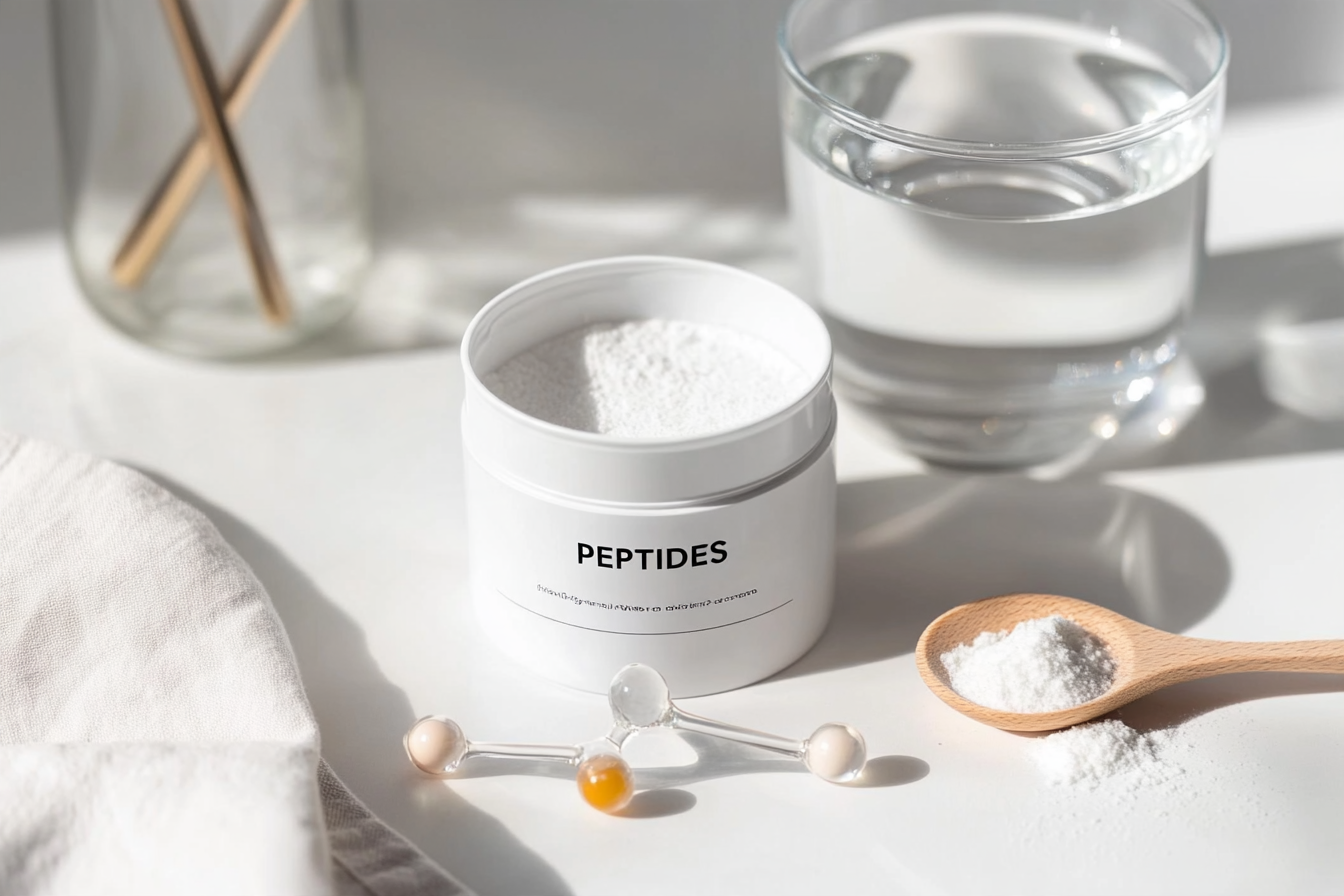
Collagen Peptides for Men: Do They Add Anything to Your Training?
Spend ten minutes on men's fitness social media and you will hear about peptides. The word is now used for almost anything, from injectable compounds sold as "research chemicals" to a scoop of powder in your morning coffee. That breadth is a problem, because those two categories could hardly be further apart in what we know about them. One has decades of food safety behind it and a growing set of controlled trials. The other is mostly rat studies and anecdotes.
Technically, a peptide is just a short chain of amino acids, the same building blocks that make up every protein you eat. Digest a chicken breast and your gut breaks it down into peptides and free amino acids before absorbing them. So "peptides" is not a special class of substance. The useful question is always which peptide, delivered how, and what the evidence says about it in actual humans.
The Injectable Peptides: Big Claims, Thin Evidence
Most of the current hype centres on injectable compounds such as BPC-157, often marketed for faster recovery from tendon and joint injuries. The appeal is easy to understand, but the evidence base is remarkably small. A 2025 systematic review in orthopaedic sports medicine looked at 36 studies on BPC-157 spanning three decades. Almost all were in animals. The only human data was a single uncontrolled case series of 12 people with knee pain, with no placebo group to compare against. The reviewers concluded that safety in humans is simply unknown and advised clinicians and athletes against using it.
The practical risks go beyond missing evidence. These products are not licensed medicines for these uses, so there is no guarantee that what is in the vial matches the label, in either identity or dose. Regulators have raised concerns about impurities and the potential for injected peptides to provoke immune reactions. BPC-157 is also on the World Anti-Doping Agency's prohibited list, which matters to anyone who competes in a tested sport. If a product needs a needle and is sold "not for human consumption", that wording is telling you something.
Thirty-six studies, almost all in rodents, and one uncontrolled series of twelve people. That is the human evidence behind the most hyped "recovery peptide" in the gym.
Collagen Peptides: The Ones With Actual Trials
Collagen peptides are a different matter entirely. They are made by breaking down collagen from animal skin, bone or hide into smaller fragments, which makes them dissolve easily and absorb well. In other words, they are a food. They are also an unusual protein. Collagen is rich in glycine, proline and hydroxyproline, the amino acids that make up connective tissue, but it is low in leucine and contains no tryptophan at all. By the usual measures it is an incomplete, low-quality protein for building muscle, which is exactly why it is interesting that a few trials have found it helps.
The early work was done in older men. A German group gave men with age-related muscle loss 15g of collagen peptides a day alongside a resistance training programme and found greater gains in lean mass and strength than with placebo. That raised an obvious question: would the same thing happen in young, healthy men who already train and already eat plenty of protein? That is a much harder test, because it is easier to show a benefit in people who are under-fed or losing muscle.
The Trial in Young, Trained Men
The same research group ran a randomised, double-blind trial in 57 men with an average age of 24. All of them were moderately trained, meaning they lifted regularly but without a structured programme, and none had used protein supplements in the previous six months. To get in, each had to squat their own body weight. Half took 15g of collagen peptides a day and half took a placebo with no calories in it. On training days they drank it within an hour of finishing. On rest days they took it at roughly the same time as the day before.
Everyone followed the same programme: three full-body sessions a week for 12 weeks, built around the squat, bench press, deadlift and bent-over row, plus a machine knee extension. Each lift was done for sets of about ten reps. The researchers measured body composition, maximum strength on the four barbell lifts, isometric leg strength, muscle thickness on ultrasound, and took thigh muscle biopsies to see how big individual muscle fibres had grown. They also collected three-day food diaries to check whether one group was simply eating more.
What Changed and What Did Not
The headline result was in fat-free mass. The collagen group gained about 2.0kg of fat-free mass over 12 weeks, against about 0.7kg in the placebo group, and the difference between how the groups changed was statistically significant. Body fat moved differently too. It stayed flat in the collagen group, at around 9.2kg, while the placebo group gained roughly 0.7kg of fat. Overall body weight rose by a similar amount in both groups, so the difference was in what the extra weight was made of.
The rest of the picture is more modest, and it matters just as much. Both groups got clearly stronger on every lift, and on the bench press, deadlift and row there was no difference between them. The squat showed a slightly larger improvement with collagen, but it fell just short of statistical significance. Type II muscle fibres, the fast-twitch fibres that grow most with heavy training, got bigger in both groups by a similar amount. Ultrasound muscle thickness told the same story: both groups grew and neither grew more.
- Fat-free mass: about +2.0kg with collagen vs +0.7kg with placebo, a significant difference.
- Body fat: unchanged with collagen, about +0.7kg with placebo.
- Strength: large gains in both groups, with no clear advantage for collagen (squat only trending).
- Muscle fibre size and muscle thickness: increased equally in both groups.
- Daily protein intake: about 1.8g per kg of body weight in both groups, already a generous amount.
So Where Did the Extra Lean Mass Come From?
This is the most interesting part of the study. If collagen had built more muscle, you would expect the muscle fibres to have grown more, and they did not. The authors' explanation is that the extra fat-free mass was largely connective tissue rather than contractile muscle. That means the extracellular matrix surrounding the fibres, along with tendons and other passive structures that transmit force. Collagen is the main structural protein in all of those tissues, so supplying the amino acids they are built from is a plausible way to support them. A companion analysis of the same group's biopsies also found more proteins upregulated in the collagen group, which suggests the supplement changed something inside the muscle beyond its size.
There is a sensible case for caring about connective tissue. Tendons and ligaments adapt to training much more slowly than muscle does, and that mismatch is one reason lifters who progress quickly can run into niggling joint and tendon problems. But stronger connective tissue is a hypothesis drawn from this data, not something the trial measured directly. "More fat-free mass" is also a broad category. It was measured with bioelectrical impedance, which counts water, connective tissue and organs as well as muscle, and is sensitive to hydration on the day of testing.
The collagen group did not build more muscle fibre or get meaningfully stronger. What they gained was harder to see: lean tissue that may be the scaffolding around the muscle rather than the muscle itself.
The Caveats Worth Knowing
No single trial settles a question, and this one has limits you should weigh. The biggest is the comparison. The placebo had no calories, so the collagen group was getting an extra 15g of protein a day while the placebo group got nothing. That shows collagen beats nothing. It does not show collagen beats 15g of whey, or 15g of protein from an extra glass of milk. The study was also funded by a collagen research institute, and the collagen supplier provided the product. The authors state the funders had no role in the analysis, and industry funding does not make a result wrong, but independent replication would carry more weight.
The sample was also small and specific: young, lean, moderately trained men eating plenty of protein. The results may not apply to beginners, to experienced lifters close to their genetic ceiling, or to women. And although the change in fat-free mass differed significantly between the groups over time, their final values were not significantly different from each other. That suggests a real but modest effect rather than a dramatic one.
What This Means for You
If you are a man who lifts and you are wondering whether to bother with peptides, the evidence points to a fairly clear set of priorities. The things that move the needle most are still training consistently with progressive overload and eating enough total protein spread across the day. Collagen peptides are a safe, inexpensive extra that may support the tissues around your muscles. They are not a substitute for complete protein, and they are not going to transform your physique on their own.
- Hit your total protein target first. Around 1.6g per kg of body weight a day is a well-supported target for building muscle, mostly from complete sources like meat, fish, eggs, dairy, soy or a whey shake.
- If you want to try collagen, the studied dose is 15g a day, taken within an hour after training. Treat it as an extra on top of your protein target, not as part of it.
- Do not count collagen as a muscle-building protein in the same way as whey. Its low leucine and missing tryptophan make it a poor stand-alone choice for that job.
- Give tendons time. Progress your loads gradually, especially when starting new lifts, whether or not you take a supplement.
- Steer clear of injectable "research" peptides. The human safety data does not exist, the product quality is unverifiable, and several are banned in tested sport.
The peptide conversation tends to reward whatever sounds most cutting-edge. The evidence rewards something duller: the foundations, done consistently, with the occasional well-tested addition on top. Collagen has earned a place in that last category, with the honest label of "promising, modest, and still being studied". The foundations are where Helic does the heavy lifting, building your meal plan around a protein target matched to your body and goals so that every supplement you choose is genuinely an extra rather than a patch.