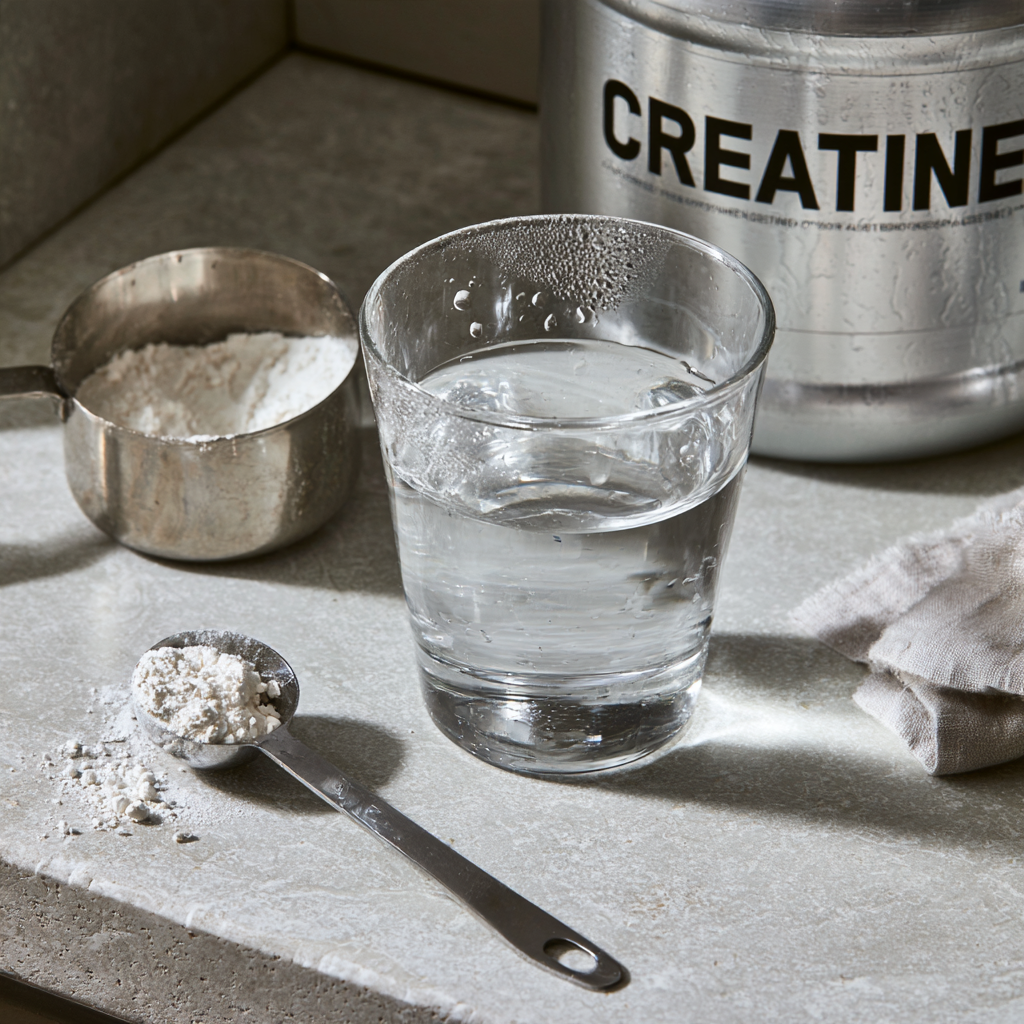
Creatine: The Most Studied Supplement in Sport, and What It Actually Does
Very few supplements survive serious scrutiny. Most arrive with confident marketing, generate a handful of promising early studies, and then quietly fade when larger trials fail to replicate the effect. Creatine is the rare exception. It has been examined in well over a thousand studies since the early 1990s, consumed in billions of servings worldwide, and it keeps producing the same result: it works. Americans alone get through more than four million kilograms of it a year. Yet despite that mountain of evidence, creatine remains the supplement people are most nervous about — usually for reasons that the research settled a long time ago.
What Creatine Actually Is
Creatine is not a foreign chemical or a hormone. It is a compound your body already makes, stored mostly in skeletal muscle, and you take in more of it every time you eat red meat or fish. Its job is to sit in your muscle as phosphocreatine, a rapidly available reserve of energy that regenerates ATP — the molecule your muscles actually spend when they contract. When you sprint, lift, or drive out of the bottom of a squat, you are burning through ATP far faster than aerobic metabolism can replace it. Phosphocreatine is what buys you those extra seconds.
The crucial detail is that a normal diet only fills those stores to roughly 60 to 80% of capacity. There is headroom. Supplementing raises muscle creatine content by around 20 to 40%, and that is the entire mechanism — you are topping up a tank you were already running partially empty. This is also why creatine does nothing noticeable for a long, steady endurance effort. Its benefit is concentrated in short, hard, repeated bouts: the exact demands of resistance training and interval work.
What It Does for Performance
The effect sizes are meaningful without being fantastical. Across the literature, high-intensity exercise performance improves by roughly 10 to 20%, with the size of the gain tracking how much your phosphocreatine stores actually rose. Practically, that shows up as better single-sprint and repeated-sprint performance, more work completed during maximal contractions, and greater gains in both strength and lean muscle mass over a training block. The International Society of Sports Nutrition describes creatine monohydrate as the most effective nutritional supplement available for increasing high-intensity exercise capacity and lean body mass — an unusually direct statement from a body that normally hedges.
It is worth being precise about how that benefit arrives, because creatine is not a stimulant. You will not feel it the way you feel caffeine. What it does is let you complete one or two more quality repetitions on a hard set, or hold your output steadier across the fourth and fifth sprint instead of falling off. On any single session that is trivial. Repeated across three sessions a week for six months, that accumulated extra training volume is precisely what drives adaptation. Creatine does not build muscle. It lets you do more of the work that does.
Creatine does not build muscle for you. It buys you the extra repetitions — and it is those repetitions, accumulated over months, that build the muscle.
How to Take It Properly
There are two legitimate routes to a full tank, and the choice between them is about speed, not effectiveness. The fast route is a loading phase: roughly 0.3 grams per kilogram of body weight per day, split into four doses of about 5 grams, for five to seven days, followed by 3 to 5 grams daily to maintain. The slow route skips loading entirely and simply takes 3 grams a day for around 28 days. Both arrive at the same saturation. Loading just gets you there in a week rather than a month, which matters if you have a competition coming and not otherwise.
- Creatine monohydrate is the form to buy — it is the most extensively studied and the most reliably effective for raising muscle stores. The pricier alternatives have never demonstrated a clear advantage over it.
- Maintenance is 3 to 5 grams a day for most people. Larger athletes with more muscle mass may need 5 to 10 grams.
- Taking it alongside carbohydrate, or carbohydrate with protein, improves how much your muscles absorb — though the performance difference over taking it plain is not dramatic.
- Timing within the day barely matters. Consistency does. What you are managing is a saturation level, not an acute dose.
- If you stop, muscle stores drift back to baseline over about four to six weeks. There is no crash and no rebound.
The Safety Question
This is where creatine attracts the most anxiety and deserves the least. The position stand concludes that supplementation of up to 30 grams a day for five years is safe and well tolerated in healthy people — a dose roughly six to ten times what any recreational lifter would use, sustained for far longer than most people supplement. Clinical trials in neurodegenerative disease have gone further still, following 1,687 patients on an average of 9.5 grams a day across 5,480 patient-years of exposure. The kidney concern, which persists in gym folklore, has been tested repeatedly in well-controlled studies and refuted each time in people with healthy renal function.
The cramping and dehydration story has fared no better. Not only does the controlled evidence fail to support it, the data points the other way: American football players taking creatine reported fewer instances of muscle cramping, heat illness, dehydration, muscle tightness and strains, and fewer total injuries than teammates who did not supplement. The gastrointestinal upset some people report is real but dose-dependent — it tends to appear when someone takes a large amount at once, and usually disappears when the daily total is split into smaller servings.
Reviewed across more than a thousand studies, the only side effect that shows up with any regularity is weight gain — and most of it is water inside the muscle, not fat.
About That Weight Gain
Weight gain is the one consistently reported effect, and it is worth understanding rather than fearing. Creatine is osmotically active: pulling more of it into muscle cells draws water in with it. The result is typically one to two kilograms appearing on the scales within the first week or two of loading, and it is intracellular water inside the muscle, not subcutaneous bloat sitting on top of it. If you are tracking body composition, expect the scales to jump early and then behave normally. If you compete in a weight-class sport, factor it into your planning. For everyone else it is cosmetically neutral at worst, and arguably the opposite.
Beyond the Gym
The more interesting frontier is what creatine does outside skeletal muscle. Your brain also runs on phosphocreatine, and supplementation raises brain creatine content by roughly 5 to 15%. In older adults this has been associated with improvements in cognitive function and working memory and reductions in mental fatigue, alongside benefits for bone density and the preservation of muscle mass that matters enormously for independence in later life. There is early work on glycaemic control in type 2 diabetes and, in animal models, substantial neuroprotective effects — reductions of 36 to 50% in cortical damage following traumatic brain injury. Treat this category with more caution than the performance findings: it is a younger literature with smaller trials, and reviews examining cognition in healthy adults have returned genuinely mixed results. Promising is not the same as established.
Who Should Be Careful
The safety data applies to healthy people at sensible doses, and that qualifier does real work. If you have existing kidney disease, or take medication that affects renal function, this is a conversation to have with your doctor rather than a decision to make from a blog post. The same applies during pregnancy, where the emerging research looks interesting but the evidence base is not yet large enough to support a confident recommendation. For adolescents, the position stand is relaxed — supervised use by serious young athletes eating a balanced diet is considered acceptable, and the panel regards under-18 warnings on labels as scientifically unnecessary — but supervision is doing real work in that sentence.
What makes creatine unusual is not how powerful it is. A 10 to 20% improvement in high-intensity capacity is useful, not transformative. What is unusual is the ratio of evidence to cost: it is one of the cheapest supplements on the shelf, and one of the very few whose benefits have been confirmed hundreds of times over. That said, it amplifies good training and adequate nutrition rather than substituting for either. If your protein intake is short, your calories are wrong for your goal, or your meals are improvised at seven in the evening, that is where the far larger gains are sitting. Get the foundation right first — Helic builds your meal plan around your actual goals and macro targets, so the supplements you add are working on top of something solid rather than papering over the cracks.