Eating Out Without Derailing Your Goals: What the Numbers Actually Say
Almost everyone who has tried to change their body composition has run into the same frustration: the week goes well, the meals are planned, the training is consistent — and then Friday arrives with a dinner reservation and the whole thing feels like it unravels. The usual response is either to avoid eating out altogether, which is miserable and unsustainable, or to write those meals off entirely and hope they do not matter. Neither is necessary. What is genuinely useful is knowing the actual size of the problem, because the research here is unusually specific, and the numbers are not what most people assume.
The Average Restaurant Main Is Larger Than You Think
In 2018, researchers collected the published nutritional information for 13,396 main meals across 27 major UK chain restaurants. The mean energy content of those meals was 977 calories. UK public health guidance suggests a main meal should sit at around 600 calories or below; just 9% of the meals analysed met that threshold. Nearly half — 47% — contained 1,000 calories or more, from the main course alone, before any starter, side, dessert or drink entered the picture.
The more surprising finding concerns which restaurants were worst. Fast food takes most of the public criticism, but the full-service chains in this study were meaningfully heavier: their meals averaged 268 calories more than the fast food equivalents. Fast food outlets were more than three times as likely to offer a main that met the 600-calorie guidance, while full-service restaurants were five times as likely to serve something over 1,000. Burgers illustrate the gap plainly. Across the whole sample, burger meals averaged 1,171 calories — and the full-service versions carried 414 calories more than their fast food counterparts.
The sit-down restaurant with tablecloths and a wine list served, on average, 268 more calories per main than the drive-through it is assumed to be healthier than.
And You Are Probably Underestimating It
The second half of the problem is perception. A large cross-sectional study surveyed nearly 3,400 people as they left fast food outlets in four American cities, asking them to estimate the calorie content of the meal they had just purchased. Adults, whose meals averaged 836 calories, underestimated by a median of 175. Adolescents were considerably further off, missing by 259 calories. Roughly two thirds of participants across the whole sample guessed low, and around a quarter were out by 500 calories or more.
Two patterns within that data matter more than the headline figure. First, the error grew with the size of the meal — the bigger the plate, the further off the estimate. This is precisely the wrong way round for anyone trying to manage intake, because it means your judgement fails hardest on the occasions when accuracy matters most. Second, perceived healthiness distorted the estimate independently of the food itself: customers at Subway guessed calorie contents around 20 to 25% lower than customers at McDonald's did. A venue's reputation quietly edits what people believe they have eaten.
Why Restaurant Food Carries So Much More Energy
None of this is sabotage. It is a straightforward consequence of how restaurant food is made and sold. Kitchens cook with considerably more fat than home cooks do — oil in the pan, butter to finish a sauce, a fryer as a default technique — because fat carries flavour and produces the texture people return for. Portions are larger because value is judged visually. Sides and sauces arrive as standard rather than as choices. And crucially, a chef is optimising for the memorability of one meal, not for the arithmetic of your week. Understanding this removes the moral framing: restaurant food is not "bad", it is simply energy-dense by design, and it should be treated as the deliberate, high-calorie event it is.
Frequency Is the Variable That Actually Matters
Run the numbers and the picture clarifies quickly. Suppose a restaurant main plus a drink lands roughly 500 calories above what you would have eaten at home. Once a week, that is 500 calories across seven days — around 70 a day, comfortably absorbed by a sensible plan and almost certainly irrelevant to your progress. Four times a week, it is 2,000 calories, which is enough to erase a moderate deficit entirely and leave you wondering why nothing is moving despite doing everything else correctly. The single most useful question is therefore not what to order, but how often you are ordering. Frequency swamps menu choice.
- Decide before you arrive. Most UK chains publish full nutritional information online, and choosing while you are hungry and surrounded by other people making choices is the worst possible moment to exercise judgement.
- Assume you are underestimating. If your instinct says 700 calories, work with 900. The research says the error is systematic and points in one direction.
- Treat the extras as the main decision. A starter, a side, two drinks and a shared dessert routinely add more than the difference between any two main courses.
- Anchor on protein. Ordering around a substantial protein source keeps you full and makes the total more predictable, whatever else appears on the plate.
- Do not skip meals beforehand to "save up". Arriving very hungry reliably increases what you order, and the deficit you banked is usually smaller than the surplus it causes.
The Salad Is Not Automatically the Answer
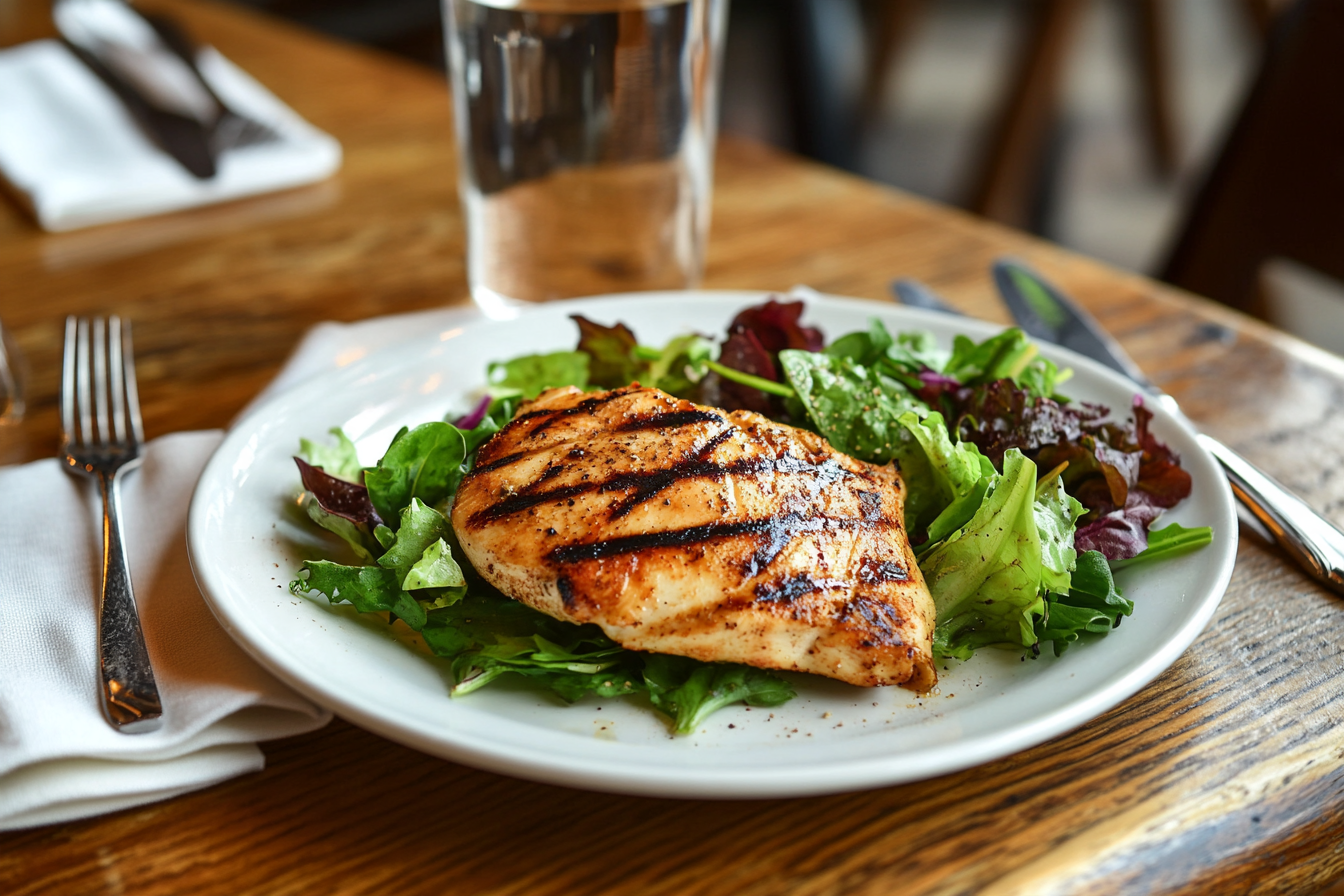
Salads in that UK dataset averaged 446 calories, which sounds like a straightforward win — and often it is. But the range hides a great deal, because dressings, cheese, croutons, candied nuts and fried protein can take a salad well past a grilled chicken dish with vegetables. The useful move is not to hunt for the item labelled healthy, but to look at how the food is cooked and what is poured over it. Grilled, baked, roasted or steamed preparations with sauces served separately give you both a lower starting point and some control. It is also worth remembering that a 600-calorie meal is a guideline, not a rule you have broken. A 900-calorie dinner inside a well-planned week is a normal event, not a failure.
Your judgement fails hardest on the largest meals — exactly the occasions when getting it right would have mattered most.
Plan Around It, Not Against It
The people who manage this well are rarely the ones with the strongest willpower in the moment. They are the ones who knew on Monday that Friday involved dinner out, and shaped the rest of the week accordingly — slightly leaner lunches, protein kept high, the deficit distributed across days rather than defended on the night. This works because it treats the meal as a known quantity in a weekly budget instead of an unpredictable shock to a daily one. It also removes the compensatory behaviour that does real damage: the punishing restriction the following day, which tends to produce hunger, poorer food decisions, and a worse outcome than the original meal ever caused.
Eating out is not a problem to be solved. It is one of the genuine pleasures of life, and any approach to nutrition that cannot accommodate a dinner with friends is not an approach you will still be following in a year. What the evidence supports is simply knowing the real numbers, respecting how consistently we underestimate them, and building a week with enough structure that a single large meal is absorbed rather than catastrophic. That is exactly the job Helic is designed to do — planning your meals around your targets across the whole week, so the nights you go out are already accounted for.